





May 20, 2026
South Burnett councillors have unanimously rejected an initial recommendation from Council staff to approve a Development Application for a Battery Energy Storage System (BESS) at the Kingaroy Solar Farm.
Councillors voted to deny approval despite noting the applicant could well challenge this decision in the Planning Court.
However, they may be hoping this legal pathway could be avoided if the State Government decided to “call in” the project, something which has occurred at a number of other BESS projects in Queensland so far this year.
This would remove decision-making from Council to rest solely with State Development Minister Jarrod Blejie.
At their April meeting, South Burnett councillors voted to “lay the matter on on the table” to investigate other options after staff recommended they approve a Development Application by M Renewables Australia Developments, subject to a number of conditions.
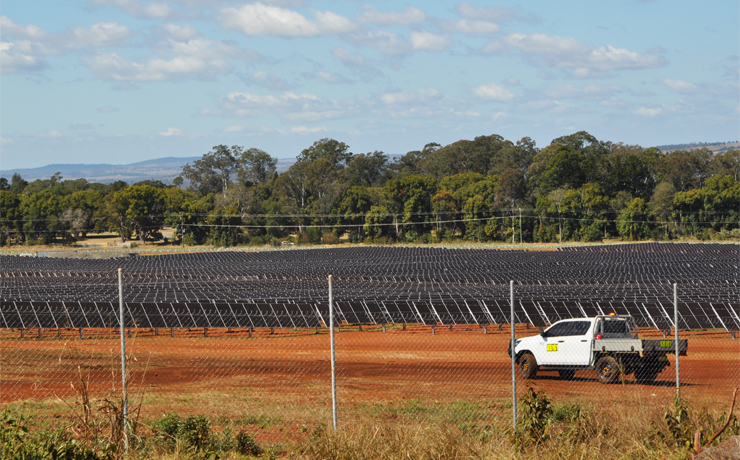
M Renewables sought a Development Permit for Material Change of Use and Reconfiguring a Lot (lease exceeding 10 years) at 397 Kingaroy-Barkers Creek Road, Kingaroy (ie. the existing Kingaroy Solar Farm).
The company wants to build a BESS with a nominal capacity up to about 100MWh within the footprint of the existing project.
The existing landscape screening would be retained as well as existing parking and access to Kingaroy-Barkers Creek Road.
Council staff concluded “the proposed development generally complies with the assessment benchmarks, or it can be conditioned to comply. Where the applicant has not provided sufficient information, conditions have been imposed to ensure compliance. It is therefore recommended that the development application be approved subject to the above conditions”.
However, local residents and other concerned citizens lodged a raft of objections to the development, with most citing construction noise, alleged health impacts, possible increased flooding on Kingaroy-Barkers Creek Road, hazards (including fire, “thermal runaway”, toxic gas dispersion, battery faults, rupture and equipment failure), and end-of-life management of the infrastructure.
At Wednesday’s meeting, councillors elected to reject the Council staff’s initial recommendation, emphasising the number of objections they had received.
Instead, they voted on an alternate motion, moved by Cr Heath Sander and seconded by Cr Deb Dennien, to refuse the Development Permit..
Cr Sander said the location was close to town, on good agricultural rural land, and Council had received multiple complaints from people in the area.
“It’s not in the best interests of the community and we have got an expectation to represent our community,” Cr Sander said.
Cr Dennien said she had received more “pushback” about this project than any other item during her time on Council.
She also suggested the size of the BESS “flew under the radar” of recent legislation.
Cr Dennien said the visual amenity of the solar farm was “clearly unacceptable” and had “very much devalued” nearby properties so it would be wrong to allow it to develop more.
“I understand there will be ongoing concerns with that … I don’t want to put our community at a greater cost if this ends up being problematic but I still have to support what my community said to me, which is they do not like it and they don’t want it to expand,” Cr Dennien said.
Mayor Kathy Duff said this project was under the amount which would require it to provide a community benefit so the developer would not have to do anything for the community.
“The community has absolutely spoken and they are not happy,” Mayor Duff said.
Cr Linda Little said the applicants were “sneakily” putting in a smaller BESS so they did not have to work with the community or Council about any community benefit for “this eyesore”.
“I am concerned that if we are going to go down the whole Planning Court route there are going to be some costs incurred and our ratepayers will have to bear the costs of that but I think with the community sentiment that it is a good decision for us to make,” Cr Little said.
Council CEO Mark Pitt said the applicant would have a period in which they could lodge an appeal to the Planning Court.
The other submitters against the application would also be advised if it went to the Planning Court so they could join the matter.
There would be mediation ordered by the court, and if it could not be sorted out at this stage, it would go to a hearing and judgment.
Cr Dennien asked if there was any chance of Minister Blejie “calling in” the project.
“That would be a discussion that would have to be had but not for the decision-making process here,” Mr Pitt said.
NB. M Renewables Australia Developments is a subsidiary of Metlen Energy & Metals (formerly known as Mytilineos), the constructors and owners of the Kingaroy Solar Farm. The initial application linked to this solar farm, by then-developer Terrain Solar, was rejected by the SBRC in 2018. Terrain challenged this in court and in 2019 an agreement was reached between the parties which allowed the project to proceed with Planning Court approval and Council incurring legal costs.
Related articles:
- Historic Milestone At Solar Farm
- Donation Boosts Men’s Shed
- Councillor Ejected From Solar Farm
- Residents Launch Solar Farm Petition
- Solar Farm To Start In August
- Meeting To Discuss Solar Farm
- Solar Farm Gets Green Light
- No Decision Yet On Solar Farm
- Mystery Clouds Solar Farm Vote
- Solar Farm Back Before Council
- Solar Farm Proposal Rejected
- Solar Farm Guidelines Unveiled
- Grazing Plan For Solar Farm
- Will Kingaroy Solar Farm Be Next?
- New Guidelines For Solar Farms
- Solar Farm Plan Submitted To Council
[UPDATED with correction]
















Proximity to residential properties is acknowledged, however those nearby ratepayers are now about to be further disadvantaged by their councillors playing “politics” by declining rather than conditioning an approval that could have been framed to deliver improved flood mitigation outcomes, buffer zone management, ongoing community contributions and enhanced environmental management.
It’s hard to imagine “removed” public servants conditioning it this way, if the owners now refer it to the State for approval.
Thank goodness coal mines didn’t have to seek development approvals through this current council to create ash dams, tailings dams, turbidity in waterways or emissions. Hard to fathom how BESS’s could have similar environmental risks when they are contained in fireproof, leak-proof infrastructure.
Looking forward to how Pauline and a videographer will solve the councillor’s fears and concerns.
This logic, if applied to other privately owned infrastructure, would be worrying for owners who aren’t maintaining their CBD or other properties in line with this decision.
Could there be another way?
I’m new in to Kingaroy but wouldn’t you want a back up? It seems blindsighted to not want this.
It is stupid to have solar without batteries.
Here’s the problem.
Most people are naturally reluctant to embrace change. Change often becomes emotional, and emotional responses can lead to irrational attitudes and poor decisions.
When this is combined with a council that positions itself as a “populist” administration, meaningful progress becomes difficult. Populist politics tends to frame issues as a divide between ordinary citizens and institutions, academics, businesses, or government. The result is that new ideas and investment proposals are often viewed with suspicion rather than assessed on their merits.
The South Burnett Regional Council campaigned strongly on this populist platform, and that is what the community voted for.
We now have a local government that regularly positions itself in opposition to State and Federal governments, has dismantled the Economic Development section within council, reduced engagement with tourism initiatives, and appears increasingly disconnected from supporting business and regional investment opportunities.
Whether people support or oppose the proposed BESS project, decisions of this scale should be based on evidence, planning, long-term economic outcomes and expert assessment, not fear of change or short-term political sentiment.
A positive (albeit small) outcome for the community. However, it’s hard to ignore that the solar farm was approved so close to town in the first place. In response to the previous comments, there are more appropriate locations for renewable infrastructure, and placing it on the outskirts of rural communities — adjacent to existing development and established properties — is not ideal.
The real concern is the growing amount of rural land being impacted by solar farms and associated infrastructure, often for limited or short-term economic benefit, which ultimately raises questions about the long-term sustainability of this approach.
It’s now on record how shortsighted they are in an energy crisis. Embarrassing.
What a shame so many people are so ill-informed and short-sighted when it comes to solar batteries and how they work.
Look up Metlen Energy and Metals, a Greek company.
Not too much difference between coal mining and lithium mining. The main difference is the stability of coal (tried and tested for at least a century) and the stability of lithium (very new in our lives and so far proving to be not as stable as every investor hoped).
Having huge batteries on the very edge of a town is maybe not such a good idea, unless of course you are one of those many wealthy investors who really don’t care.
There’s a perfectly good coal-fired power station and a coal mine just down the road. It was a huge waste of money building the solar farm in the first place. Why waste even more money on batteries?
Another kneejerk reaction from populist pandering councillors.
Like the failed attempt to block a new Telstra tower, this is likely to cost ratepayers funds in a legal battle. Does the council not have better ways to spend our rates?
Secondly the argument about the BESS being “heavy industry” – it comes nowhere near such a definition. The telephone exchange would be more “heavy industry” than a BESS already located at an existing solar farm.
We need a council that listens to qualified staff, that is concerned for our environment and not trying to keep us in the early 20th century whilst pandering to a vocal minority – educated, at best, by social media and Murdoch press coal lobbiests.
Everyone complaining about it being ‘heavy industry’ and close to a residential area must drive past Swickers with their eyes shut.
This council runs the very real risk of turning away much-needed regional development because of this continual playing of populist politics.
Time for the adults to step in and take control.