




April 4, 2022
Member for Nanango Deb Frecklington used a Parliamentary debate last week to again highlight the plight of South Burnett farmers who have been caught up in regulations designed to protect the Great Barrier Reef.
The regulations require permits for activities on their farms, despite their properties being hundreds of kilometres away.
Katter’s Australian Party moved a Bill which would have repealed the regulations, while the LNP moved a substantive amendment. Both were defeated.
Mrs Frecklington said she had been calling on the State Government to remove the South Burnett and western Gympie regions from the reef regulations, or delay their commencement, since the laws were moved in September 2019.
“Just over a year ago more than 200 primary producers from my region attended a public meeting in Kingaroy to understand the looming reef regulations and how they would affect and impact their business,” Mrs Frecklington told Parliament.
“The Kingaroy meeting had the biggest turnout across the State … this was at the height of COVID. When everyone else was staying at home, these residents of mine were so concerned they came out in droves.
“There were 200 people who attended at the height of the pandemic to try to understand why they were being impacted so severely by Labor’s regulations in an area and in a part of Queensland that the science says does not go anywhere near the Great Barrier Reef.
“The main question asked was why the South Burnett is even included in the legislation. Given that water from the South Burnett and the western Gympie regions would only ever reach the sea during times of extreme flood, the regulations that impact these farmers on a daily basis demonstrate that this one-size-fits-all regulation should not be imposed on that region.
“Importantly, these meetings exposed the fact that there is no baseline data and no water quality testing is undertaken in the South Burnett.
“The only monitoring station is located at Mount Lawless, which is north-east of Gayndah and well downstream of the entire South Burnett and western Gympie regions.”
She said the Environment Minister had later acknowledged there was no upstream water quality monitoring prior to water entering the Burnett River.
“I highlighted for the Minister that water from the Burnett catchment starts at the Bunya Mountains, some 215 kilometres by road and, therefore, an even further distance by the time it travels through our rivers and creeks to Mount Lawless, not to mention that much of our water sits in BP Dam, Gordonbrook Dam and Boondooma Dam before it even has a chance to enter the Burnett River,” Mrs Frecklington said.
The water then flowed into Paradise Dam before it could flow out to sea.
“It is also acknowledged in the Minister’s response that the discharge of sediment from the Burnett River only occurs following flood conditions,” Mrs Frecklington said.
“This is something that our farmers and producers tried to explain to the departmental staff at the meetings.
“They know that during major flood in our region nothing will stop the flow of sediment. They also know that water moves laterally across the landscape and can deposit sediment in grass country, not just straight into our creeks.
“I asked another question of the Minister, and that was about waving permit fees for producers in my region to address the negative mental health effects caused by the regulations and to offer them an incentive in good faith to become more engaged in the process. Unfortunately this was not considered. Meanwhile these regulations continue to have a serious effect on primary producers who are languishing under the pile of red tape that this Labor government has imposed on them.
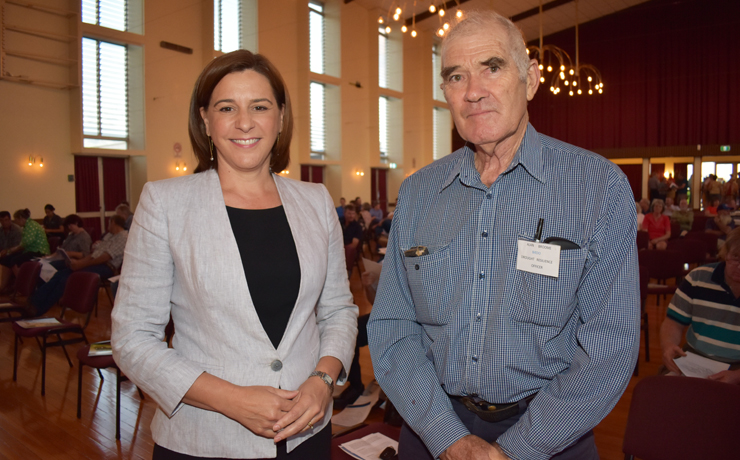
“I thank Mr Alan Broome and Mr and Mrs Peter and Margaret Hunt who made a submission to the committee on this Bill. They spoke about the need for the South Burnett to be removed from these regulations.
“Alan, Peter and Margaret are all cattle producers who have land on Barker Creek and Reedy Creek.
“If water flows from their properties, it eventually runs into BP Dam. This water can sit for many years before a flood spills it into Barambah Creek. It seems wrong that these regulations are therefore being imposed on them. The question to rightfully ask is why.”
- External link: Mrs Frecklington speaking in Parliament
* * *

AgForce Queensland later released a statement saying it was “saddened” and “disappointed” the KAP Bill to reverse Barrier Reef regulations was voted down by both the Labor Party and LNP.
AgForce Reef Taskforce chair Alex Stubbs said the current reef regulations were based on “outdated science” and were subjecting farmers to “unnecessary red tape and record-keeping”.
“The latest research from the Great Barrier Reef Marine Park Authority confirms the biggest impacts to reef health are rising ocean temperatures due to climate change, damaging tropical cyclones and crown-of-thorns starfish outbreaks, not agriculture runoff,” Mr Stubbs said.
However, the LNP Shadow Environment Minister Sam O’Connor said the KAP Bill was deeply flawed.
The LNP proposed an amendment, which was then voted down by KAP and the ALP.
Mr O’Connor slammed the two parties for refusing its move to protect farmers in reef catchments.
“Farmers are rightly frustrated at being solely blamed for the water quality of the Great Barrier Reef,” Mr O’Connor said.
“They are our partners in environmental protection.
“The Katter Party’s ‘Reversal of Great Barrier Reef Protection Measures’ Bill was not the right way to better recognise primary producers and to incentivise best practice.
“It was deeply flawed and would have made things worse for both farmers and our environment.
“The Parliament has rightly and overwhelmingly rejected this disappointing attempt by the Katter Party to use farmers as political pawns.”
Related articles: