





October 29, 2015
The region’s towns and localities will soon be signposted in a new way.
Cr Damien Tessmann told Wednesday’s SBRC meeting old locality signs have started being removed, and will be replaced with new signs soon – possibly before Christmas.
Existing locality signs were created by the South Burnett Local Government Association (SBLGA) in the early 2000s in an effort to bring some uniformity to the way the region was signposted and create a “South Burnett brand”.
The SBLGA was an informal organisation covering the former Nanango, Kingaroy, Wondai, Murgon, Kilkivan and Rosalie Shires.
It was created to allow the old Shires to work together on joint problems and tackle trans-Shire issues in a co-ordinated way, including regional signage.
However the implementation of the new signs ran into several problems as it was rolled out.
One was that different Shires elected to use different sign sizes; and another was that some Shires had only recently re-badged their own signs and couldn’t fully implement the program due to budget constraints.
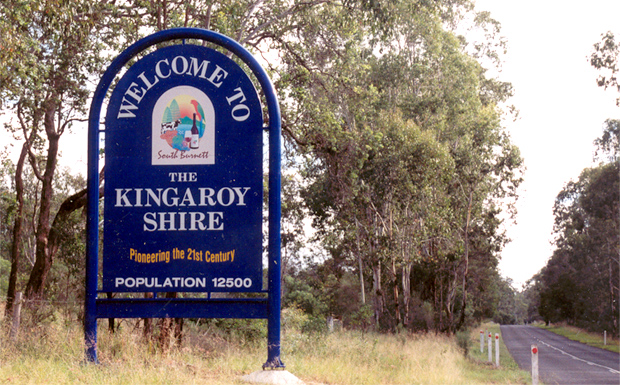
The South Burnett Regional Council erected uniform regional entrance signs soon after it was formed in 2008, but left the old locality signs in place.
The uniform signage program follows one recently undertaken by Toowoomba Regional Council to bring a standarised and professional look to its own towns and villages.
* * *
Council has agreed to waive a one-time $493 Food Business Licence Application Fee for a new community cafe the Wesleyan Methodist Church intends to set up at 55 Cairns Street, Nanango.
Councillors heard the church wants to set up the new cafe to assist the less fortunate in the area by providing subsidised meals on Friday nights, similar to Danny’s Diner in Kingaroy which is run by several Kingaroy churches and assisted by Kingaroy State High School students.
The motion to waive the application fee will not relieve the church of its obligation to pay an annual licence fee, Council officers said, but this will be considerably less.
The motion to waive the fee was moved by Cr Ros Heit and seconded by Cr Barry Green, and carried unanimously.
* * *
Two parks will receive new names this week.
Wooroolin’s park will be renamed Dalton Place on Friday, October 30 to honour one of the town’s long-standing families.
And land donated for a public park by Bridgeman Downs owner Jan Brydges will be officially named Brydges Park during Moffatdale State School’s centenary celebrations on Saturday, October 31.
* * *
The South Burnett’s long-awaited new Planning Scheme – which will weld together and standardise the former Murgon, Wondai, Kingaroy and Nanango Shire Planning Schemes – has almost been finalised.
Council officers are currently working on flood overlay mapping to ensure it aligns with data recently received from the Department of Natural Resources and Mines regarding the Queensland Flood Mapping Program.
The aim is to produce a more accurate overlay and suggest changes in land zonings affected by potential flood hazards.
This work is expected to be completed by the end of October, after which the plan will be resubmitted to the Minister for Local Government for approval to bring the Draft Planning Scheme out for public consultation and comment.
Planning Portfolio chair Cr Keith Campbell said he hopes this will occur before the next Council elections in mid-March 2016.
A detailed public consultation plan is being developed as part of the process.
* * *
Patronage at Lake Boondooma and Bjelke-Petersen Dam continues to grow.
Between July 1 and October 25 this year, 16,554 people stayed at Boondooma Dam and 13,284 at Yallakool.
Cr Barry Green said the figures were jaw-dropping.
“We’ve had almost 30,000 people paying to stay at our dams in the last four months,” he said.
“If you added in the number of people who stay at the Bunya Mountains – and I don’t know where those numbers could be obtained – we are now drawing more than 100,000 tourists a year to just three locations in our region.
“I don’t think some people realise just how big tourism is.”