





April 15, 2026
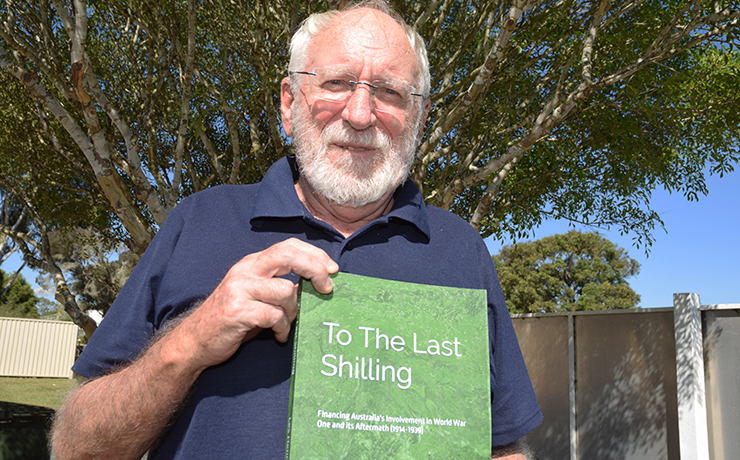
Retired Kingaroy economist Dr Les Henning is breathing a sigh of relief after his 345-page study exploring the financing of Australia’s involvement in World War I has finally come back from the printers.
Dr Henning began writing “To The Last Shilling” in 2014 and finally pushed the keyboard away earlier this year, although he admits he wasn’t working on it full-time.
The title refers to a statement by Australia’s fifth Prime Minister, then Opposition Leader and Wide Bay MP Andrew Fisher (Labor), who declared during his successful 1914 Federal Election campaign that Australia should be prepared to contribute to the Allied cause in Europe “to the last man and the last shilling”.
“Turn your eyes to the European situation, and give your kindest feelings towards the Mother Country at this time. I sincerely hope that international arbitration will avail before Europe is convulsed in the greatest war of any time. All, I am sure, will regret the critical position existing at the present time, and pray that a disastrous war may be averted. But should the worst happen after everything has been done that honour will permit, Australians will stand beside our own to help and defend her to our last man and our last shilling …”
“Australia’s official war history had only a brief treatment of war financing, so I thought there was an opportunity for future work,” Dr Henning said.
He conducted his research in Australia’s National Archives and at the British archives in Kew, London, which he visited twice.
The book explores how Australia funded its involvement in the Great War and the continuing cost to the nation up until 1939.
“The total cost of the Commonwealth’s involvement in World War I and its entailed costs, including repatriation and debt servicing, was almost £1 billion (in 1918 prices) with about 10 per cent of it owed to Britain,” Dr Henning said.
He argues that during this long process of paying for the war, the Federal Government achieved financial dominance over the States by introducing Commonwealth income and company taxes as a wartime initiative in 1915. This eventually led to the abolition of State income taxes, and a State dependence on Commonwealth funding.
Dr Henning left the South Burnett in 1964 to pursue further education and a career in the public service.
The former Kingaroy State High School student then worked as an economic consultant for a number of international organisations, including the World Bank, Asian Development Bank, the United Nations Development Program, the International Monetary Fund and USAID, and in countries including Afghanistan, Iraq, Vietnam, Cambodia, Laos, Bangladesh and across Oceania.
He returned to the South Burnett after his retirement.
- “To The Last Shilling” can be ordered on Amazon
[Disclosure: Les Henning is treasurer of Burnett News Inc, the not-for-profit association established to run South Burnett Online]











Congratulations on your publication, Les! No doubt your dedication to this project over such a long period has paid off, not only for you as a personal achievement, but it will also go down as a documented part of Australia’s history.