





June 18, 2013
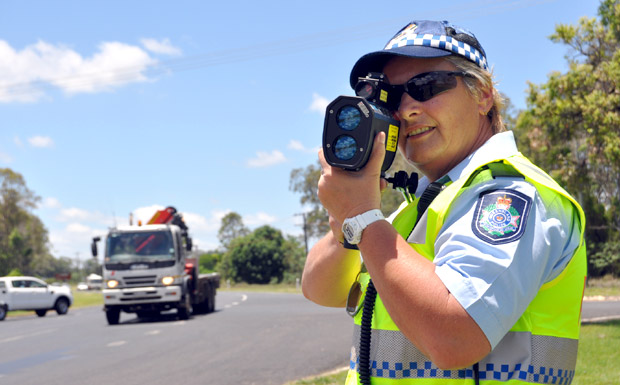
Police will start publishing the location of speed cameras as part of new road safety initiatives to be rolled out on July 1.
Commissioner Ian Stewart said there would also be a reduction in speed “tolerances”, ie the small speeds “over the limit” that police may choose to ignore when issuing tickers.
“We need to take a stand as the road toll is unacceptably high,” Commissioner Stewart said.
“Speeding kills and we will continue to enforce the speed limit in an effort to make our roads safer for all.”
The road toll is currently 138 which is 16 more deaths than the same time last year, 28 more than in 2011 and 30 more than the same time in 2010.
In 2012, there were 59 fatalities as a result of crashes involving speeding drivers or riders within Queensland, representing 21 per cent of the road toll.
Commissioner Stewart said changes were being announced now to give drivers advance warning.
“We want all road users to take personal responsibility and join police in working to reduce the road toll,” he said.
“Changes to speed tolerances will be incremental over time, and will be guided by evidence such as the road toll and public compliance with the speed limits.
“The level of speed tolerances won’t be revealed to avoid creating a de facto speed limit.
“The speed limit is the maximum. It is not a guide or a recommendation. We hope to not see an increase in the number of tickets issued at all.
“If you obey the speed limit, and treat it as a limit rather than a guide, you won’t receive a ticket.”
From July 1, the Queensland Police Service will begin publishing speed camera locations throughout Queensland on the police website.
* * *
According to the RACQ, the accuracy of vehicle speedos is covered by Australian Design Rule 18.
Until July 2006 this rule specified an accuracy of +/- 10 per cent of the vehicle’s true speed when the vehicle was travelling above 40km/h, ie. for a vehicle travelling at 100km/h, the speedo was allowed to indicate between 90km/h and 110km/h.
From July 2006 newly introduced models of a vehicle – and from July 1, 2007, any newly manufactured vehicle (excluding mopeds) – must comply with Australian Design Rule 18/03.
This new rule requires that the speedo must not indicate a speed less than the vehicle’s true speed or a speed greater than the vehicle’s true speed by an amount more than 10 per cent plus 4 km/h.
Speedos must also always read “safe”, meaning that the vehicle’s true speed must not be higher than the speed indicated by the speedo.
That is, at a true vehicle speed of 100km/h the speedo must read between 100km/h and 114km/h.
An alternative way to look at it is; at an indicated speed of 100km/h, the vehicle’s true speed must be between 87.3 km/h and 100km/h.
Speedos are not permitted to read lower than the actual speed of the vehicle.