




February 1, 2017
A breakthrough by CSIRO-led scientists has made the world’s strongest material more commercially viable, thanks to the humble soybean.
Graphene is a carbon material that is one atom thick.
Its thinness and high conductivity means it is used in applications ranging from miniaturised electronics to biomedical devices.
These properties also enable thinner wire connections, providing extensive benefits for computers, solar panels, batteries, sensors and other devices.
Until now, the high cost of graphene production has been the major roadblock to its commercialisation.
Previously, graphene was grown in a highly-controlled environment with explosive compressed gases, requiring long hours of operation at high temperatures and extensive vacuum processing.
Now CSIRO scientists have developed a novel “GraphAir” technology which eliminates the need for such a highly-controlled environment.
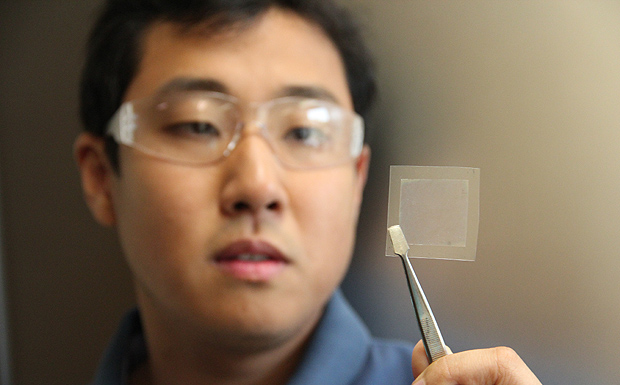
The technology grows graphene film in ambient air with a natural precursor, making its production quicker and easier.
“This ambient-air process for graphene fabrication is fast, simple, safe, potentially scalable, and integration-friendly,” CSIRO scientist Dr Zhao Jun Han said.
“Our unique technology is expected to reduce the cost of graphene production and improve the uptake in new applications.”
GraphAir transforms soybean oil – a renewable, natural material – into graphene films in a single step.
“Our GraphAir technology results in good and transformable graphene properties, comparable to graphene made by conventional methods,” Dr Dong Han Seo said.
With heat, soybean oil breaks down into a range of carbon building units that are essential for the synthesis of graphene.
The team also transformed other types of renewable and even waste oil, such as those left over from barbecues or cooking, into graphene films.
“We can now recycle waste oils that would have otherwise been discarded and transform them into something useful,” Dr Seo said.
The potential applications of graphene include water filtration and purification, renewable energy, sensors, personalised healthcare and medicine, to name a few.
Graphene has excellent electronic, mechanical, thermal and optical properties as well.
The CSIRO are also looking to partner with industry to find new uses for graphene.
Dr Han and Dr Seo co-authored a paper published in Nature Communications which announced their discovery.
Researchers from The University of Sydney, the University of Technology Sydney and the Queensland University of Technology also contributed to the work.